
Services
Operating support built around the problem.
Peakline helps manufacturers address performance problems, scale operating discipline, and execute major initiatives when the need is too important to leave unresolved and too specific to justify building a permanent team around it.
Project-based, fractional/interim, and advisory support available.
Start a ConversationCore offer 01
Stabilize & Improve
Find the constraint. Stabilize performance.
This work is for plants or manufacturing networks where results are slipping, the true cause is unclear, or the organization needs experienced operating leadership to restore control and build a credible recovery path.
Discuss a Performance Problem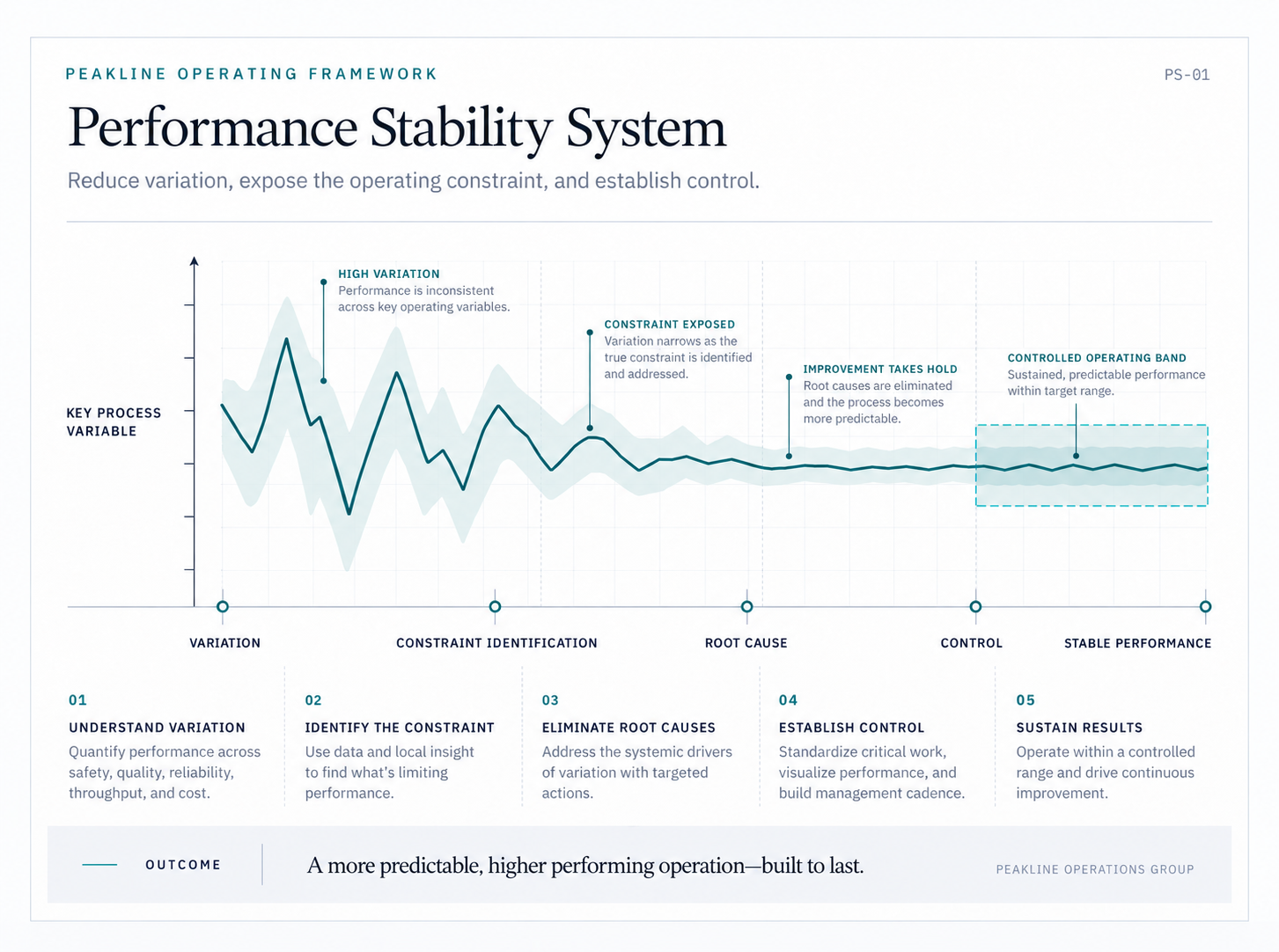
When to bring Peakline in
- Throughput, reliability, quality, cost, or delivery performance is deteriorating.
- Leadership sees symptoms but the true operating constraint is still unclear.
- The plant is stuck in recurring firefighting.
- Management cadence or accountability is inconsistent.
- The issue is important enough to require experienced operating leadership now.
What Peakline leads
- Validate the actual operating condition and separate facts from assumptions.
- Identify the primary constraint and the next likely constraint.
- Build a focused recovery plan with clear ownership, timing, and decision points.
- Establish stronger daily and weekly operating cadence, escalation, and accountability.
- Coordinate safety, quality, reliability, throughput, labor, waste, and cost as one operating system.
What changes
- The real constraint becomes clear.
- Leadership aligns around a prioritized recovery plan.
- Ownership and operating visibility improve.
- Firefighting gives way to disciplined execution.
- Performance improves against the metrics that matter most to the business.
Core offer 02
Scale & Standardize
Build consistency without forcing every plant into the same mold.
This work is for organizations where growth, acquisitions, multiple sites, or uneven leadership practices have created inconsistent execution. The goal is to build common operating discipline while preserving legitimate differences between plants.
Discuss a Multi-Site Challenge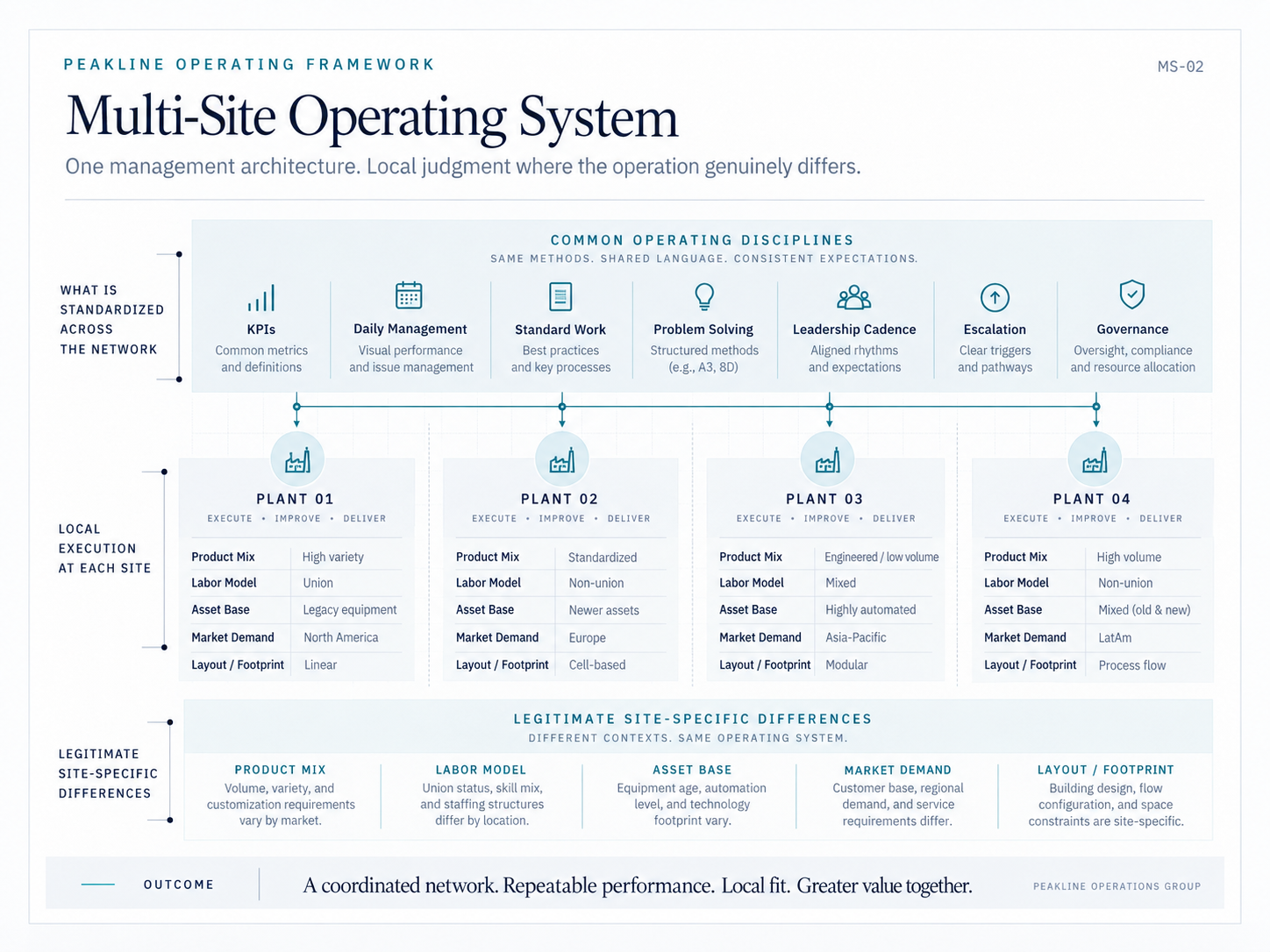
When to bring Peakline in
- Plants measure or manage performance differently.
- Best practices exist but do not transfer consistently.
- Growth or acquisitions are creating operating strain.
- Leadership wants standardization without unnecessary bureaucracy.
- Site-to-site variation is affecting safety, quality, delivery, cost, or customer service.
What Peakline leads
- Compare how sites actually operate and identify meaningful variation.
- Separate what should be standardized from what should remain site-specific.
- Establish common KPIs, operating rhythms, escalation paths, and accountability.
- Identify network constraints, capacity risks, and opportunities to rebalance work.
- Transfer proven practices across the network and strengthen leadership routines.
What changes
- Plants operate with clearer common expectations.
- Network-level visibility and priorities improve.
- Proven practices spread faster.
- Unnecessary variation is reduced.
- Local leaders retain the authority needed to run their operations effectively.
Core offer 03
Transform & Execute
Turn major initiatives into operating results.
This work is for capital, automation, technology, industrialization, and operating-model initiatives where the business case is important but execution risk is high. Peakline helps bridge the gap between strategy, engineering, operations, and actual adoption.
Discuss a Transformation Initiative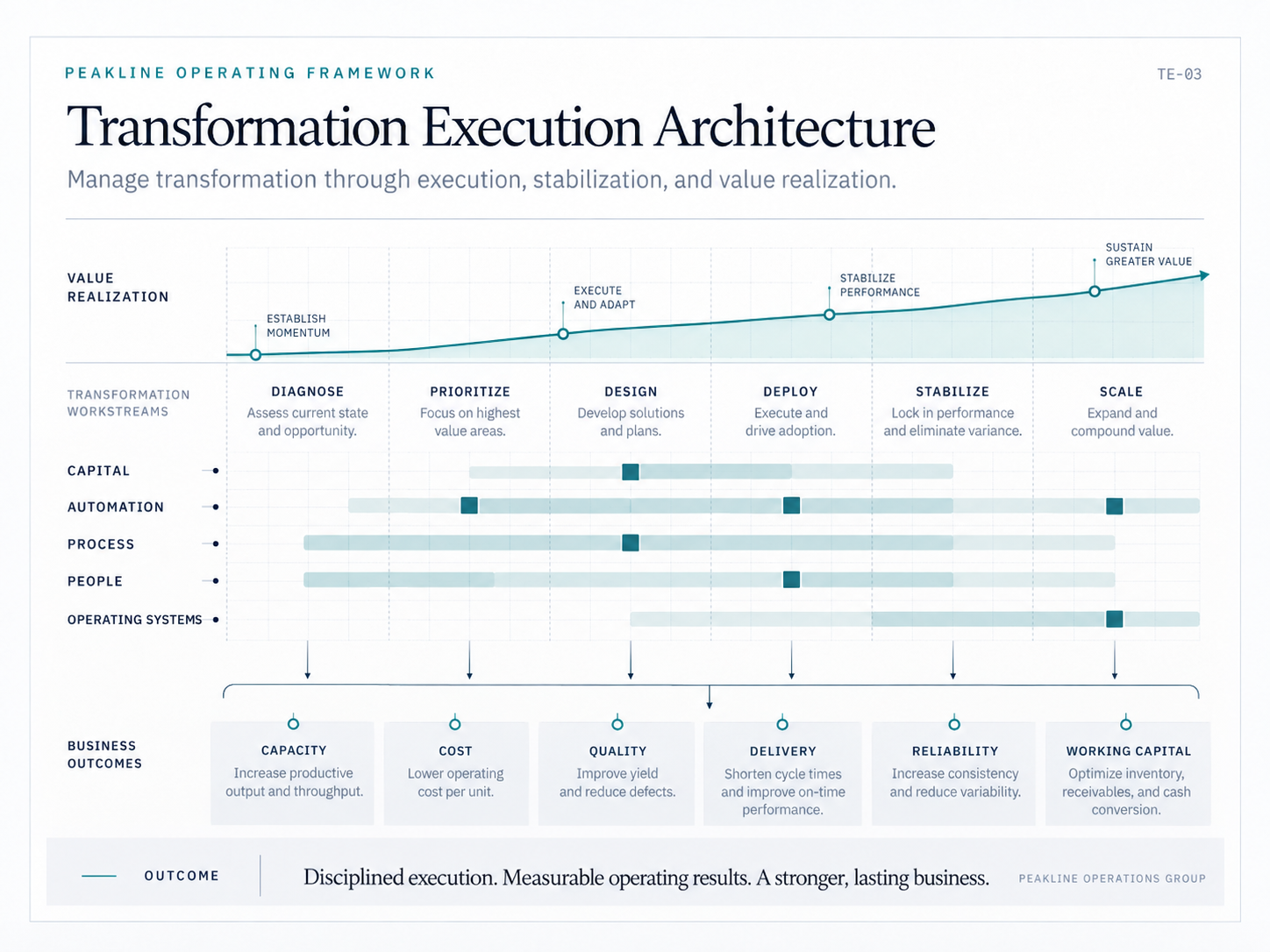
When to bring Peakline in
- A major capital, automation, or technology initiative needs stronger operating ownership.
- Technology is being introduced without a clear connection to the operating problem.
- A new product, process, or manufacturing capability needs to move into repeatable execution.
- Multiple vendors, functions, or sites must deliver one operating outcome.
- Leadership needs experienced operating judgment to pressure-test assumptions, risks, timelines, and readiness.
What Peakline leads
- Clarify the business problem, desired operating outcome, and success criteria.
- Pressure-test capital, technology, capacity, implementation, and change assumptions.
- Align engineering, operations, IT/OT, suppliers, vendors, and leadership around execution.
- Build readiness, commissioning, acceptance, and transition plans.
- Establish milestones, ownership, governance, and escalation through implementation.
What changes
- Investment is more clearly tied to business outcome.
- Execution risk is reduced.
- Cross-functional and vendor ownership improves.
- Projects transition into stable operations faster.
- Leadership has clearer evidence that the solution is ready to scale.
Engagement Models
How Peakline Engages.
The engagement model should fit the problem, not the other way around.
Project-Based
Defined scope, timeline, and outcome. Best for a specific operational challenge, capital initiative, plant performance effort, or implementation problem.
Fractional / Interim
Senior manufacturing leadership for organizations that need experienced operating support without immediately adding permanent executive headcount.
Advisory
Ongoing senior-level support for manufacturing strategy, operating systems, capital priorities, automation roadmaps, plant performance, or leadership decisions.
Working together
What to expect.
Facts before assumptions
Start with the actual operating condition, not the preferred explanation.
Operator-level involvement
Senior involvement from the first conversation through execution.
Practical recommendations
Recommendations must work in the real plant, with real people, real constraints, and real economics.
Clear ownership
Every priority should have an owner, timing, expected outcome, and decision point.
Let's talk about the operating problem.
You do not need a finished scope of work. Start with what is happening, what it is costing the business, and what is getting in the way.
Start a Conversation